

Intelligence Failure
A Democratist's Analysis of the Iran War, Modern Government, and the Epstein Class

Here’s a high-level/big-picture democratic analysis of our current situation. It may be useful to read it with the context of the evolutionary foundations of democracy I discussed here. The first in my series on core concepts in democratics is here.
Background
Over the past 10,000 years or so, since the beginnings of significant-scale agriculture and food storage technologies, we have seen a recurring pattern in the development of human agriculturally-based communities with significant storage technology: populations begin small, fall apart, re-organize at a larger scale, fall apart, re-organize at a larger scale, and the cycle repeats, each time a larger population under a common government—until it falls apart again.
We see this pattern starting with places like Çatalhöyük around 10,000 years ago (~8,000 BCE), a community that grew to around 8,000 people. Then the city-states of ancient Mesopotamia were larger, 10 to 50 thousand people or so. Many times these city-states conquered each other, formed alliances, and governed larger populations, bringing many cities and regions around them under one oligarchy1, then falling apart again.
In every place around the world where we find an evolution of agriculture and food storage past a certain point, we see this same pattern emerge. Human organizations—governments or religions for example—grow larger, outcompeting rivals, collapse or split up into smaller units, begin growing and competing again, grow larger again, collapse or split, and so on, in a repeating cycle.
We can see the same pattern in stone. Ancient peoples around the world discovered—with many mistakes leading to collapses along the way—that the easiest way to build tall structures was in layers: large layers below, increasingly smaller layers above—ziggurats, stepped pyramids, and pyramids. When engineering knowledge is limited, this is more or less the only way to build tall. Human organizations often work the same way. The easiest way to organize large populations is through hierarchy: a broad base at the bottom, multiple layers of sub-hierarchies in the middle, and a much smaller group in control at the top.
And this makes sense, up to a point. Hierarchy is a real solution to a real problem. If you need to coordinate thousands or millions of people and you don’t already have advanced communications, high trust, distributed education, or strongly networked institutions, hierarchy can be a powerful tool. It compresses complexity. It reduces the number of people who need to know what is going on. It allows decisions to be made quickly and orders to be transmitted efficiently.
But the easiest way isn’t always, or even often, the most effective or efficient way.
Our physical architecture has evolved, but our organizational architecture hasn’t.
Modern Day
Every capitalist corporation today is organized as a top-down command and control dictatorship, the strictest hierarchy. The same organizational structure as Pharaonic Egypt or the ancient city-state of Ur—or the USSR or North Korea or the US government, or China’s or Brazil’s or Cuba’s or Germany’s or Japan’s or any other current or past. Look at their organizational charts and they are nearly identical clones of each other, no changes that make any significant difference to the information processing necessary to good group decision making: they are all horrifically bad for those purposes, with the exact same failure modes.
This is the capitalist organizational structure.
Every capitalist corporations is structured this way, or a simple variation that doesn’t change the fundamental hierarchy. This structure defines capitalism. It is the only structure that allows the few at the top to control the cash flow between consumers and producers, giving owners the power to take profit without doing any of the work; some do some work, some just own stock. Either way, it is this structure that gives owners the power to extract wealth from the system without working. What we call “unearned income”. Without this structure, capitalist institutions can’t exist2.
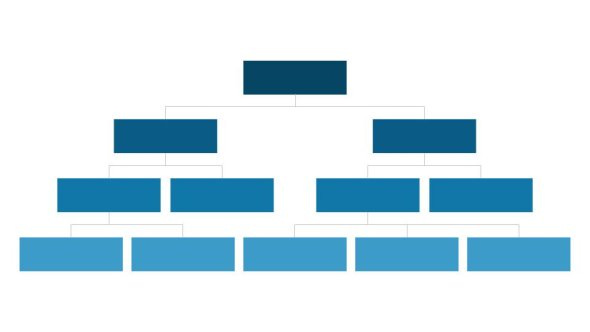
The one stand out difference is China, which has evolved a workaround that doesn’t change the structure, but iterates it in a way (a glimpse of this can be seen in the “birdcage economy” analogy). This, together with their education and organized political promotion system gives them some additional growth and strength, but not that much and not without other costs. That’s a discussion for a another day.
Hierarchy always has costs.
First, it throws away information. The people at the top do not directly experience most of the reality below them. Information has to travel upward through layers, and at every layer it gets filtered, distorted, delayed, simplified, politicized, or censored. It has to be compressed, because there aren’t enough hours in the day for one or a few decision makers to absorb all the information. Even if everyone is being scrupulously honest, just that much compression ensures bad news is softened, complex reality is reduced to bullet points, abbreviated footnotes, or just left out. In the real world of power relationships and consequences, uncertainty is often repackaged as confidence, or hidden. Again, even if everyone is scrupulously honest, and much more so if everyone is an about average human being, as nearly everyone is. By the time “reality” reaches the top of the pyramid, it is already at least half-fiction, however many nuggets of reality poke through in odd patterns, because the vast majority isn’t even present at all.
Second, hierarchy selects for loyalty over truth. The higher you go in most hierarchical systems, the less people are rewarded for being accurate and the more they are rewarded for being useful to those above them. That does not mean everyone at the top is stupid. Often the opposite. It means intelligence is bent toward status maintenance and advancement rather than reality contact. People learn to say what preserves their place in the structure, and the places of the people on their side in the power network. Good people do this, or they don’t get far in the power structure. That’s one way good people end up doing horrific things.
This is why we see so many cardboard cut-out shills for the oligarchy. Newsom and Buttigieg and Harris, or McMorrow or Stevens or Masdaam or Slotkin or Brink. They are vapid because the system they conquered to get where they are selects for loyalty over truth. The selection mechanism is the negotiation process between the big donors and the 99%. The big donors have been selecting the people that serve them best and can get elected. To serve the donors best, you don’t support universal healthcare, because there are big donors that pay you not to. You don’t support abolishing ICE or ending the war or stopping a genocide, because the prison- and military-industrial complexes have wealthy shareholders why pay you not to. You craft messaging carefully around the demands of the 1% so that you can talk as if you’re on the side of the 99% while dog whistling to the big donor class that you’re a safe pick for them.
So you sell your fundamental position to the big donors, and then you try and figure out how to sell as much of that position as possible to the 99%. This is the “logic” of the “public option” in healthcare or supplying just “defensive weapons” to an army committing genocide.
That’s the cynical view of it. What happens more often is candidates spend careers learning what the oligarchy finds acceptable. They spend careers molding themselves to fit the oligarchs’ worldview. They don’t need to be bribed, they’ve been grooming themselves like slaves in training their whole careers to audition for the position of overseer for the oligarchy. They’ve learned to say things in a way the public hears what they want to hear, and the oligarchs hear their servant speaking their code:
“The public option” = keeping the murder for profit business model legal.
“Defensive weapons” = protect the Zionists committing genocide.
“Border security” = keeping the immigrant terror machine funded.
“Public-private partnership” = letting corporations skim profit from public necessity.
“Fiscal responsibility” = starving public systems so private profiteers can replace them.
The people want universal healthcare, ICE abolished, and an end to war and genocide. The big donors want to keep committing genocide, murdering people for profit, imprisoning people for profit, and so on—just like the manufacturers of Zyklon-B. This is how they make money.
Candidates like McMorrow, Stevens, Slotkin, Masdaam, and Brink—and the rest of the establishment shills—are not running to end the healthcare racket. They are auditioning for the job of overseeing it: negotiating with us over how many of our family, friends, and neighbors the Epstein class gets to kill, and how much they get to charge us for the “service.” Right now, we spend about $450 billion more on healthcare each year than a universal system would cost, only to get worse coverage, worse care, and declining life expectancy. This system also kills about 68,000 poor people every year by denying or delaying care, disproportionately women and minorities. All of these candidates support keeping that murder-for-profit model legal.
Third, hierarchy tends to centralize not just power, but social insulation. The top of the pyramid becomes its own habitat. The people there increasingly live among each other, marry each other, fund each other, protect each other, and adopt the same blind spots. They stop being a leadership layer within a society and become a separate organism feeding on society. Epstein is just one example we found out about.
This is where intelligence failure enters the picture.
By “intelligence failure” I don’t mean a CIA or similar failure to gather information or analyze it accurately. I don’t mean we got the wrong analysis, report, satellite image, or threat assessment. I mean a failure of the social system that metabolizes the data into those analyses, reports, and assessments, and the iterated systems that metabolize that information into action.
The failure of the social system of thinking and reasoning collectively.
The failures of the social architecture through which information is interpreted. The problem is not usually that nobody knew about the many problems. The problem is that the system could not metabolize what was known into appropriate action because information processing has been bottlenecked, or accountability has been eliminated near the top of the hierarchy, usually both.
Since the information wasn’t metabolized into the top of the hierarchy, and because they just really don’t care, the Epstein class is reliably pretty clueless about what’s happening in the real world. When people criticize them, they react defensively. Any hierarchical system, like the US Government or the Catholic Church or the Epstein class as an organism, will always act to protect itself first, far ahead of the people it claims to care about. Witness the pedophilia scandal in the Church: hierarchies protected themselves decades and centuries before they protected the children explicitly under their care. Similarly, Epstein and his friends’ crimes were well-documented inside both Democratic (certainly Biden and probably under Obama) and Republican (Trump, maybe Bush) administrations, and the only person prosecuted was Maxwell. The billionaire Les Wexner wasn’t even questioned, despite his obvious long-term involvement with Epstein, including giving Epstein direct power over Wexner’s billions for no clear reason. The choice to not question a material witness isn’t being taken at the top, it’s being taken in the middle to make sure it doesn’t effect the top—people playing the game, making themselves useful to the top. The first thing the hierarchy does is protect itself.
This is true in war.
It is true in finance.
It is true in policing
It is true in public health.
It is true in elite crime.
And it’s true in most everything else.
The same kind of society that repeatedly produces catastrophic foreign policy errors also repeatedly produces protected internal predator classes. That is not a coincidence. It is the same structural phenomenon.
No one who has read the history of human societies over the past 10,000 years was at all surprised by the horrors in the Epstein files.
They’ve read about the Royal Death Pits of Ur, most of the murdered were young women (about 90%). In the Roman Empire, Caligula is just the most famous example. Or around the same time, Paul telling Christian slaves—many of them children, many used as sex slaves—to obey their masters as if their masters were “Christ” himself, with the explanation that otherwise, their Roman rapists might think poorly of the Christian “god”. We can’t have that! The slaves, including child sex slaves, are instructed by Saint Paul to cooperate with their regularly rape to protect the reputation of “god”. The same way more recently priests kept and keep silent to protect the reputation of the Church. The Founding Fathers and their systematic enslavement and abuse of Black people, and their regular practice of raping enslaved Black women—information massively suppressed for centuries to protect the reputation of slavers and rapists, because they were “Founding Fathers” and “Framers of the Constitution”. The hierarchies act as informational organisms with tactics honed by 10,000 years of cultural evolution for survival.
Take war with Iran.
You do not need everyone involved to be irrational for the system to act irrationally. You need a narrative dressed up in a story about how things should be in the world, and you need a hierarchy.
Narrative: the US dictates, other countries obey.
Story: “we’re the good guys protecting the world!”
Hierarchy: US leaders at the top, most powerful at the tip of the pyramid.
Trump and his crime family are so brainwashed by the story, many appear to think it means they can’t do anything wrong, by definition. “Everything we do is fine because we’re us.” Which is just supremacism. This is exactly the attitude of religious fanatics: “god is on our side, we can do no wrong.” Many of the wealthy among them just don’t recognize rules or boundaries because they’ve usually gotten around them in the past, and that’s taught them they can get around them when they want, so this kind of religious thinking isn’t even necessary, though they sometimes delude themselves anyway.
Just being in the upper echelons of a hierarchical society disconnects you from reality.
Even regular people don’t need to believe in the story or the narrative much to go along with it, especially if the decision making structure is a hierarchy. The structure itself incentivizes punishment of dissent, while career incentives reward aggression, media institutions launder state narratives, and political elites are insulated from the human costs of their decisions. Under those conditions, the machine can move toward disaster while many of the individuals inside it remain convinced they are being prudent relative to their incentives, even if they don’t really buy the story. With a hierarchy, no religiosity or absolutism or similar needed. The structure itself incentivized compliance with the story and narrative, even among non-believers.
Paul explains the prudence of slavish obedience to rape, because if Christian slaves refuse their masters demands, what will their masters, the people with wealth and power in society, think of Christianity? Paul wants to build Christianity and he needs to support of the wealthy and powerful. So he throws the most vulnerable under the bus to serve the ambitions of the hierarchy now called the Catholic Church.
This is the same thing politicians like McMorrow or Stevens or Slotkin or Brink or Masdaam or other establishment Democrats are doing when they support a “public option” rather than eliminating the murder for profit system, or supplying “defensive weapons” to a country committing genocide and other war crimes, rather than stopping the genocide. They’re throwing the most vulnerable under the bus to serve their paymasters. Often they aren’t even bribed particularly, they just agree with the worldview that murder for profit must be legal. They don’t think about it that way, but that doesn’t change the fact that they support murder for profit business models remaining legal.
This is a clear expression of totalitarianism: those at the bottom must sacrifice and suffer to protect those at the top. The uninsured (“public option”) and Palestinians (“defensive weapons”), have to suffer whatever the supremacists in the story (politicians representing their paymasters) decide they must. “It’s just the way things are” in a totalitarian system. The individuals aren’t important, only the hierarchy is important, beginning with it’s reputation. The Royals of Ur are the Royals, Augustus is the Emperor, or there’s “God,” or the Founding Fathers, or the Catholic Church: spoken like “don’t you know how important they are?!!” You find a culture of expected reverence in each case. This is the same attitude with which Zionists denounce Iran having ballistic missiles, or even attempting to make nuclear weapons, as totally unacceptable, while Israel has ballistic missiles with nuclear weapons mounted in them. This is Zionism asserting it’s supremacism, dictating to others what they’re allowed while accepting no limitations or accountability for its own genocidal behavior.
The machine does not need wisdom.
It just needs a story, a hierarchy, and some momentum.
It can’t have wisdom. Wisdom comes from large groups of diverse minds with wide networks of interconnections with different sources of information3, not small groups of elites at the top of hierarchies saturated with the same narratives and stories. Inbred ideas aren’t any better at producing healthy results than inbred organisms are at producing healthy offspring. "Royals, for example, were sometimes severely inbred.
And the same goes for the Epstein world.
What the Epstein case exposed was not just one monster or even one network. It exposed a class reality. A layer of wealthy, connected, mutually protective people living above normal accountability. A social stratum for whom law is negotiable, publicity is manageable, and scandal is survivable so long as the right relationships remain intact. Again, not an exception to the hierarchical system, just a highly concentrated expression of it. The more concentrated, the less intelligent, and often the more depraved.
The public is often encouraged to think of these as separate issues. Foreign policy over here. Sex trafficking over there. Corruption somewhere else. Media failure somewhere else. But that fragmentation is itself part of the failure. These are not disconnected scandals.
They are different outputs of the same organizational structure: hierarchy.
When power rises upward and accountability weakens as you climb, reality becomes optional at the top.
That is the core problem at the moment.
A society can be technologically advanced and still be organizationally primitive. It can have artificial intelligence, precision missiles, global markets, real-time communications, and still rely on political forms that are functionally Stone Age: steep hierarchies, elite kinship networks, priestly information gatekeepers, opaque decision-making, and ritualized public myths to hold the whole thing together.
We should not be surprised, then, that such a society produces both imperial overreach and elite impunity. Those are two of the oldest and most common products of hierarchy.
The deeper problem is that hierarchy scales power, but doesn’t scales intelligence. It can gather labor, wealth, weapons, and obedience at enormous scale. But it is much worse at gathering truth, accurate information, verified facts, and even worse at processing those into material action capable of addressing real issues well. And once a system becomes large enough, truth is more important to ensures stability than speed or concentrations of power.
A ruler can force action.
A ruler cannot force reality to change.
The increasing oil shocks are an elegant example: futures trading eventually relies on real oil, and real oil really is constrained in ways that only labor and time can change.
This is why oligarchies so often look strong right before they fail.
From the outside they appear formidable: massive institutions, disciplined messaging, impressive monuments, giant militaries, enormous fortunes. But internally they are brittle. They are full of frightened subordinates, corrupted feedback loops, suppressed knowledge, and leaders making decisions inside information bubbles of their own construction.
They are pyramids.
And pyramids are stable only under certain conditions. They can endure tremendous weight from above. They are much worse at adapting sideways. They do not learn easily. They do not redistribute stress well. They do not welcome feedback from the bottom. Their great strength is rigidity, and this is sometimes sufficient at a small enough scale or sufficiently limited scope. Their great weakness is also rigidity, and this is fatal at any significant scale or scope.
A democracy worthy of the name must do something much harder than building a pyramid. It must build a society that can think and reason at scale.
That means institutions that do not aggregate obedience, but instead aggregate knowledge and independent thought. It means shortening the distance between lived reality and decision-making. It means rewarding truth-telling over flattery. It means designing systems where people closest to a problem can communicate what they know without passing through layers of careerist or other filtration. It means creating forms of collective intelligence strong enough to outperform hierarchy, not merely condemn it.
Resistance and revolution, not just protest.
That is the challenge of our time.
Because the choice is not between hierarchy and no organization. The choice is between stupid empires and intelligent democracies. Between systems that concentrate power until reality escapes their grasp, and systems that distribute power enough for reality to remain visible to and have direct impact on decision makers.
The Iran war, the Epstein class, the recurring collapse of public trust, the obvious inability of elite institutions to correct themselves even after repeated disaster—these are not random malfunctions. They are warning signals from a civilization hitting the limits of stone age governance structures.
The old solution to scale was hierarchy.
Our task now, the democratist program, is to invent, implement, and evolve better solutions for scaling our organizations. We have the science to guide us, and the science on collective decision making and implementation is crystal clear at least about how to start: Dr. Elinor Ostrom’s 8 Core Design Principles for sustainable management of common resources (2009 Nobel Prize in Economics), which include:
Authority to self-govern = political democracy.
Equitable distribution of costs and benefits = economic democracy.
Neither of these are even possible with hierarchy.
Both require equal participation and equitable distribution.
Hierarchies don’t do equal or equitable, by definition: the people at the top give themselves more than they an equitable share, because the systems are designed to ensure they have that power via the pyramid model. That’s why hierarchies exist in human organizations: to make a few people more powerful than everyone else. That’s the narrative. The story is, “because they’re better at making decisions.”
They aren’t, and can’t be. Because they aren’t a large, diverse group of individuals thinking independently and weighing all their voices equally. That’s how you make better decision more often, as discussed here.
We have 10,000 years of evidence it never works well, and the longer it lasts the worse it gets, until the next one comes along.
The revolution we need is out of hierarchy and into democracy.
//
To be clear, monarchies are just the most extreme form of oligarchy. Because, especially past a few thousand people at most, one person simply cannot physically process all the information necessary to make all the important decisions competently. It is physics constraint on governance. Monarchies are always oligarchies, just with a primary figurehead who may or may not have more power than other oligarchs.
Just to be clear, capitalism is not markets. Capitalism is a production management system. A market is a distribution management system. Markets exist without capitalism. Capitalist corporations compete with socialist and feudal and other production management systems in the same markets. I go into more details on the distinction between capitalism and markets and give examples here.
This is a major part of the thesis in Dr. Joseph Henrich’s The Secret of Our Success (Princeton, NJ: Princeton University Press, 2016).